

Universities manage considerable volumes of sensitive data, intellectual property, research outputs, and confidential information. Yet cyber security is still too often viewed as a technical issue rather than a strategic risk. Cyber security for universities is now a regular board-level concern for universities, with clear knock-on effects for reputation, compliance, finances, and the ability to keep the institution running smoothly.
As cyber threats grow in sophistication and frequency, higher education leaders must understand not only the security risks but also the frameworks, responsibilities, and solutions that protect their institutions.
This article explores the essentials of cyber security for universities, the four core pillars that reinforce effective protection, the developing threats, and how universities can increase their cyber resilience.
Cyber Security for Universities: Understanding the Four Core Pillars
Cyber security for universities goes past firewalls and software. According to sector guidance for higher education, effective cyber security is built on four interconnected pillars:
- Governance
- Assurance activities
- Technology
- Culture.
Together, these pillars create a viable, organisation-wide approach to managing cyber risk.
1. Governance
Governance identifies how cyber security is owned, led, and implemented within the institution. For universities, this means ensuring clear accountability at senior leadership and board level, with cyber security recognised as a strategic risk alongside finance, safeguarding, and compliance.
Strong governance includes setting risk appetite, approving cyber security policies, allocating appropriate resources, and ensuring senior leaders receive regular, meaningful reporting on cyber risks and incidents.
2. Assurance Activities
Assurance activities provide confidence that cyber security controls are effective and aligned with established standards. This includes routine risk assessments, audits, penetration testing, and compliance checks.
For universities, external frameworks such as Cyber Essentials for education can offer a structured baseline, helping institutions demonstrate due diligence while detecting gaps that require further investment or attention.
3. Technology
Technology forms the operational backbone of cyber security for universities. This contains secure networks, identity and access management, endpoint protection, data encryption, and backup systems.
However, technology alone is not enough. It must be correctly configured, constantly monitored, and regularly updated to reflect evolving threats and institutional needs.
4. Culture
Culture is often the most underestimated pillar. Universities are open environments by nature, with large, diverse user populations including students, researchers, academics, and third-party partners.
A strong cyber security culture that invests in security measures guarantees that staff and students understand their role in protecting systems and data. This includes awareness training, clear policies, and leadership that visibly prioritises cyber security as a shared responsibility.
Higher Education Under Threat: Why Cyber Security Has Never Mattered More
Cyber-attacks on educational institutions are no longer isolated events. Government research consistently shows that higher education is one of the most targeted sectors in the UK.
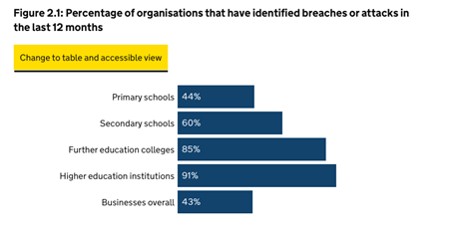
According to the Cyber Security Breaches Survey 2025, 91% of higher education institutions reported experiencing a cyber security breach or attack in the last 12 months. This compares to 85% of further education colleges and notably lower figures across primary and secondary schools.
Even more concerning is the frequency of cyber attacks. Further and higher education institutions were far more likely to experience cyber incidents on a weekly basis (30%), compared to just 9% of primary schools and 16% of secondary schools. Among institutions that identified a breach, universities also reported a wider range of attack types than businesses overall.
These figures underline why cyber security challenges for universities can no longer be treated as hypothetical. Universities are appealing targets due to their valuable research data, decentralised IT environments, and large user bases. A single successful attack can disrupt teaching, compromise research, damage reputation, and incur significant recovery costs.
Cyber Security Challenges for Universities: Safeguarding the Future of Higher Education
The cyber security challenges for education are varied and continually evolving. Universities need to defend against multiple threat vectors simultaneously, often with limited internal resources.
- Phishing and impersonation attacks remain one of the most common risks. Attackers exploit trust by posing as senior leaders, IT teams, or external partners to trap students and staff into revealing credentials or authorising payments.
- Ransomware attacks and data breaches can cripple university operations, encrypting critical systems and demanding payment to restore access. These attacks repeatedly target research data and student records, placing institutions under immense pressure.
- Malware, spyware, and viruses can infiltrate systems through compromised devices or unsafe downloads, leading to data loss, system downtime, or unauthorised access.
- Denial of Service (DoS) attacks aim to overwhelm university networks, disrupting online learning platforms, admissions systems, and digital services during critical periods.
- Social engineering attacks: Social engineering attacks against schools and colleges exploit human psychology rather than technical flaws to gain unauthorised access to sensitive data or funds. Attackers often use phishing emails that impersonate school leaders or exam boards to trick staff into revealing login credentials, or vishing (voice phishing) calls where they pose as IT support to “fix a glitch” by asking for a password.
Together, these risks highlight why cyber security for universities must be proactive, layered, and continuously reviewed.
Cyber Security in Universities: How to Keep Institutions Safe
Successful cyber security in universities starts with people and leadership. Board members and senior leaders play a vital role in setting expectations, asking the right questions, and ensuring cyber risk is actively managed.
National guidance consistently emphasises that cyber security is a leadership and governance issue, not solely an IT concern. It requires clear ownership, appropriate investment, proper risk management and accountability at the highest level.
However, leadership alone is not enough. Universities must combine strong governance with practical, day-to-day security controls and security practices that reflect the realities of open academic environments, diverse user groups, and valuable data.
1. Strengthen Identity and Access Management
Managing who can access systems and data is one of the most effective ways to reduce risk.
Universities should:
- Enforce multi-factor authentication (MFA) for staff and students
- Apply least-privilege access, ensuring users only have access to what they genuinely need
- Automate access removal when students graduate or staff leave
These measures significantly reduce the impact of stolen or compromised credentials, which remain a leading cause of breaches in higher education.
2. Invest in Cyber Awareness Training
Technology alone is not enough. Human error remains a major vulnerability, particularly in busy academic environments.
Effective training should cover:
- Recognising phishing and social engineering attempts
- Safe password and account practices
- Secure use of personal and mobile devices
- Data handling and privacy responsibilities
Short, regular awareness sessions are far more effective than annual tick-box training and help embed good security habits across campus.
3. Secure Research and High-Value Data
Universities hold data that is both sensitive and highly attractive to attackers, particularly research outputs.
To protect sensitive and personal information from data breaches, institutions should:
- Segment networks to isolate sensitive research environments
- Apply additional controls to grant-funded, regulated, or commercially sensitive projects
- Encrypt data at rest and in transit
Not all data needs the same level of protection, but critical assets must be clearly identified and prioritised.
4. Improve Endpoint and Network Security
With thousands of laptops, tablets, and mobile devices connecting to university networks, endpoint security is essential.
Best practice includes:
- Keeping devices patched and up to date
- Using endpoint detection and response (EDR) tools
- Actively monitoring network activity for unusual behaviour
This helps universities detect threats early and limit lateral movement across systems.
5. Prepare for Cybersecurity Incidents Before They Happen
Cyber incidents are not a question of if, but when. Preparation makes the difference between disruption and crisis.
Every university should have:
- A clearly documented incident response plan for when an incident occurs
- Regularly tested backups
- Defined roles, responsibilities, and escalation paths
- Communication plans for staff, students, regulators, and partners
Fast, coordinated responses can dramatically reduce operational, financial, and reputational damage.
6. Review Third-Party and Cloud Risks
Universities rely heavily on external platforms, including:
- Cloud learning environments
- Research tools and collaboration software
- Student information and management systems
Regularly reviewing supplier security standards and data protection practices is essential to managing shared responsibility and compliance risk.
7. Technology, Partners, and Platforms
Beyond governance and internal controls, universities benefit from working with experienced specialists who understand the education sector.
Partnering with a trusted IT support provider offering IT services for education enables access to sector-specific expertise, proactive monitoring, and scalable security solutions aligned to higher education needs.
Adopting modern platforms such as Microsoft 365 can also strengthen cyber resilience. When properly configured, Microsoft 365 provides built-in security capabilities, including:
- Secure identity and access management
- Advanced threat protection
- Data loss prevention and compliance tooling
These features help protect users and information across devices, locations, and learning environments.
Final Thoughts
Cyber threats are now a permanent feature of the higher education landscape. For university leaders, understanding cyber security challenges for education is critical to protecting institutional reputation, research integrity, and student trust.
By embedding strong governance, investing in assurance and technology, fostering a culture of awareness, and partnering with experienced providers, universities can move from reactive defence to strategic resilience. Ultimately, cyber security for universities is not just about protection, it is about defending the future of higher education itself.
Is your institution truly protected against modern cyber threats?
Qlic provides expert IT support and cybersecurity tailored to the unique needs of universities. Partner with us to increase your protection and secure your institution’s future.
Book a consultation!